


Not that long ago, I was eight months pregnant and living on stitched-together patches of sleep. In front of me: planning for new motherhood, dealing with pregnancy (ouch!), all while working in startup land. I struggled to find time to write. Sometimes I wrote at 3AM in the morning if the baby kicked me awake or gave me one of those yelp-inducing punches to the bladder (this is known as “lightning crotch”—yes, seriously it’s a thing).1 Other times, I wrote late at night to get myself to go to sleep. And, more often than not, it came out as scribbled notes in my iPhone with autocorrect changing half of what I was trying to say.
For most of my life, writing things down was a way for me to understand things better. But as I became more and more sleep-deprived, as my body changed, I found it harder and harder to write. The massive adventure ahead of me of pregnancy, giving birth, becoming a mother—it was daunting. It was no small fact that my identity, life, and known world would be subject to massive upheaval. I didn’t know how to make sense of it. I felt lost and insecure.
Pregnancy: I wanted to understand it. I wanted to catalog it. I wanted to explain it, tell the stories of pregnancy. Yet all I could write were the worst clichés, and then wincing, knowing that that wasn’t it. How could I go through something so deeply human and yet struggle for words to explain it?
I decided to use my friend’s Clarity Card process2 as a structured way to journal towards the end of my pregnancy. The method is simple and beautiful, and I ended up in tears just by having this as a guide. Below, I’ll walk you through the four-step process he outlines — and how I used it to chart out ideas, insights, and clear perspectives on being pregnant. Plus, I’ll include some of my original notes from when I wrote this out when I was eight months pregnant. It helped me.
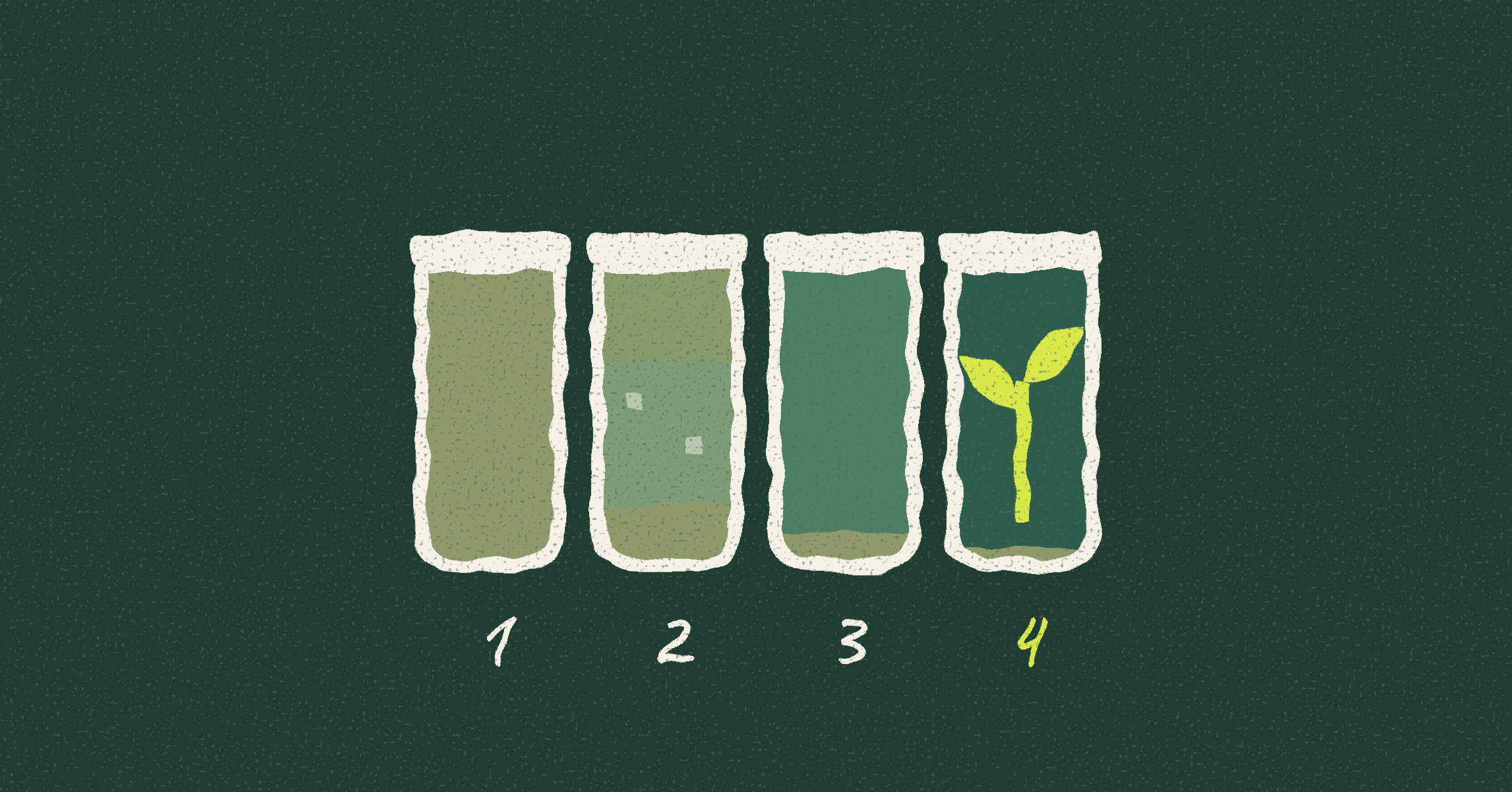
A 4-Step Guided Framework for Journaling and Gaining Clarity
Much like Julia Cameron writes about in The Artist’s Way, just getting pen on paper and making a list can be an extraordinary way to dive into your mind. The mind, I’ve learned, is an incredible tool that can be cued with phrases and questions. All you have to do is let your mind respond to the questions you put forth.3
Here’s how I did it:
Full credit goes to Mathias Jakobsen of Think Clearly. These are his Clarity Cards, which I purchased, and they are fantastic (no affiliate link, just love).
The deck of cards was surprisingly easy to use. They walks you through four steps.
For each step, you take 2–3 minutes to write down as much as you can. You can go longer if you’d like, or keep it short and simple.
The first step is the simplest, and by getting your pen onto paper quickly, it makes the process easier.
Prep: Grab some pages to write on.
I have a Moleskine I love using, and so I cleared fresh sheets and got out a teal blue pen to write with, because that sounded like fun. Make sure you’re not distracted (I prefer a Moleskine or loose paper on a desk without any other items on it — no computer, phone, or other distractions.
Also, have a timer ready. The timer is important.
There’s research that shows that limited-duration journaling (10 to 15 minutes, no more than 20 minutes) is very effective, but if you go for longer—especially when it comes to trauma—it might not be as helpful and could even end up being harmful.)
Choose a topic or area of focus.
Choose a topic or a subject. I suppose you could just let something tumble out, or try to define a problem. For my sake, and as the example in this essay, I chose “Pregnancy” as the topic, because I was struggling to understand it, and these prompts helped me unpack it.
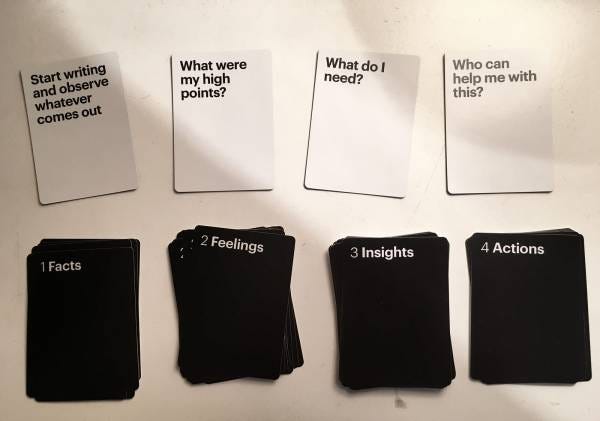
I then stacked the four sets of cards out face-down in front of me in four piles, and started a timer.
There are four sets of cards:
Facts (what happened)
Feelings (how you feel about it)
Insights (interpretations or analysis)
Actions (things you can do)
Step 1: The Facts
The first set of prompts is related to “the facts.” I pulled my first card, and it simply said, “What are the facts?”
I began by making a list.
I am pregnant.
I have swollen and sore feet.
I am doing Mathias’ Clarity Cards.
I’m in the 9th month.
I weigh 40-50+ pounds more.
I don’t fit into my shoes anymore.
No one stands up on the subway for me.
It takes me 2-3 hours to stop barfing in the morning.
I pulled another card and continued listing facts.
The prompts said things like “What is going on?” and “What is happening?”
I continued:
I cry so much more than I thought I would. Probably every day. I just can’t stop crying? It feels like the tears are always at the ready. I’m so emotional, and everything is so big.
I don’t know many other people who are pregnant right now.
Everyone at the office is younger than me.
My observations: It was easier than I thought to begin with a simple list of what the facts are. Even just the act of writing “I am pregnant” somehow makes it seem more real. I know, of course, that I’ve got a watermelon belly and I’m waddling around the city stopping to pee at every coffee shop I can find, but still — it helps to list out all of the pieces of this puzzle, no matter how obvious they are. There’s something about writing it down and getting out of the swirl of my head that just helps.
Lists are really helpful. It’s not writing, per se. It’s just making a list. And that, in itself, is the way to ease into it. The act of list-making can be profoundly useful as an instrument for getting inside of your own mind and beginning the process of journaling.
Never underestimate the power of making lists.
Step 2: Feelings
The second set of prompts asks you to write down how you FEEL about the situation. Prompts included questions like “What gives you energy?” and “What are you sad about?” and other guided questions to help you understand how you feel about the situation.
Again, I spent a quick 3-4 minutes on the next blank page in my journal, jotting down as much as I could—about a minute per card, writing whatever came to mind first.
Observations: It was wonderful to parse out facts versus feelings. It’s one thing to be pregnant (fact), and it’s a completely separate thing to have a set of feelings about it (excited! happy! scared! kind of in shock!). My list included things like “I feel like a beached whale,” and “My stomach is really tender in the center,” and “I feel much more vulnerable and in need of protection than my normal, ambitious, athletic self.” It went from physical feelings to deeper emotional layers, like “I feel like my identity is transforming,” and “there are parts of me that are changing so quickly, it’s hard to get used to.”
Some of the harder stuff to write down:
I feel really tender and scared, and vulnerable. I’m afraid that people might run into me, or push me over, or hurt me and my baby in some way.
I feel absolutely sick to my stomach about the subway smells and the horrific underground heat, it makes me scratchy and itchy and miserable.
I feel deeply alone and unsettled, like I’m doing this all on my own. Where are the other women who have done this before? Why does everything I read about pregnancy feel like a lie? I feel really lost and confused, and the branding and messaging around pregnancy feels like a shiny superficial thing—it doesn’t seem real to me. It doesn’t seem like anyone is actually speaking the real truth about what happens.
Reflections: In journaling, it can be difficult to separate out feelings and facts, and then things get very jumbled. Yet this four-step method felt like I’d discovered a shockingly easy way to do it. In addition, the act of taking time to focus just on feelings let a lot of them tumble out. If you’re not used to talking about your feelings, having a guided set of cards prompt you through it can help you find awareness.
It’s one thing to be pregnant (a fact), and it’s a completely separate thing to have a set of feelings about it — feelings which are complex, layered, and individual.
Step 3: Insights
The third set of questions invites you to probe a bit further. This step takes you from observation to analysis.
What are you learning, deducing, and understanding?
How are you interpreting these facts and feelings?
What insights have you gained?
I stumbled a bit here, because the first question was “What insights have you gained?” and I felt myself think dismissively, “Um, none.” So I began this third step the same way I’d done before, which was: keeping it simple and starting with the basics.
My first insight? “Drinking a lot of water helps the headaches go away.”
From there, it became easier to write out insights, and because I was writing quickly, it was almost startling how fast I dug into deeper insights. Once I started, it was like they were ready to come tumbling out of me. “Rest yourself as often as you recharge your iPhone, if not more,” and “It’s your own learning process and your own journey, unique to you,” and “Take time to reconcile external readings and advice with your own internal wisdom.” These made it onto my list of insights about the experience of pregnancy.
Wow, yes, this. I didn’t know I had this in me. And I didn’t know just how much I needed to read this and see this written down.
“Your feelings about this matter, even if you don’t see yourself reflected in other people’s stories.” — “It’s okay to feel heartbroken and alone when you don’t have any family around you.” — “It is objectively miserable to be puking all of the time—having a stomach bug for a few days is awful enough, doing it for nine months is horrible!” —“Trust yourself, and keep writing things down.” —“Don’t let other people tell you how you are supposed to be feeling.”
I felt smarter just writing it down. Nodding my head. It was like the wisdom was there all along, but I didn’t have a clear way of seeing it.
Intuitively, I know that each of these things is true. Somehow the act of writing them down made them stronger, more powerful. They reminded me how important they are. They clarified, for me, what insights I have at my fingertips, if I’m willing to sit for a few minutes and record, reflect, and listen.
It was like the wisdom was there all along, but I didn’t have a clear way of seeing it.
Step 4: Actions
The fourth and final section is about creating a set of actions that you’re going to take.
What can you do with what you’ve observed, noticed, and felt?
What steps can you take next?
Again, I was confounded at first. What “actions” do I take with “pregnancy”? There was a list I could draw up quickly, like “pack your hospital bag, set up an email auto-reply, stock your freezer with food,” but those seemed like just another list of tasks and errands. I could make a to-do list in my sleep; how could I apply this more broadly to a reflective session focused on the holistic concept of “pregnancy” and everything that it entailed?
But the magic of putting a prompt in front of your brain is incredible. The brain wants to find patterns, ideas, and solutions. When you put a set of frameworks in front of your mind, and give it a beat or two, it begins to generate answers for you.
Again, within a few moments, the ideas came forward. They seemed both obvious and silly, which was my experience throughout doing the cards. I wrote them down:
Decisions to be made:
— It’s okay for the baby to come.
— We are ready.
— This will be great.
— We can handle this.
What am I going to do?
— Give birth.
— Become a mom.
— Work hard during labor and delivery!
— Rest fully and recover well.
What is the next step?
— Rest. Allow. Enjoy. Be.
— Ask for help.
— Brainstorm ways to feel less alone.
— Ask for pregnancy and birth stories, and talk more to people who have been through this before.
The power of putting words to paper continues to astound me.
And the deepest exhale.
Twelve to fifteen minutes of writing later, and I felt a renewed sense of calm about the transition that was about to come for me. Recognizing that then, at the end of my pregnancy, I was getting ready to meet my little boy and bring him into the world — this made me tear up.
And it’s okay. It’s okay that I’m scared. It’s okay that I’m a jumbled-up mess of feelings. It’s okay that this is overwhelming. I’ve never done this before, and I need a lot of support. This is a massive upheaval to my life, a shift in identity, and a physical challenge that I’ve never done before. This is a lot, Sarah. This is a massive work of art, an identity shift, a radical transformation.
The next things to do are to acknowledge that all of this is happening.
And to decide: decide that it’s okay, that we’re ready, and that it’s time.
And also to rest, allowing the process to unfold.
I am terrified, I am in awe, and I am on a brave adventure. One I’ve never been on before.
Of course it makes sense to be feeling this way.
— Sarah K Peck
Leadership ☀︎ Business ☀︎ Parenting ☀︎ Mindset ☀︎ Humor
🟡 Let’s Talk: SKP Newsletter — Join 11,000 readers!
🟠 The Startup Parent Podcast — Business stories, real talk.
🟣 The Wise Women’s Council — A leadership incubator for business women deep in the mess and joy of midlife, big work, and career callings.
You can also find me on LinkedIn, Substack Notes, and Threads.
PS: If you’re thinking about applying to join us in the Wise Women’s Council this year, Spring Applications will open in the next few weeks. We’d love to see you apply if you’re looking for a community of driven, business-focused women navigating ALL the mess and joy life brings us.

EVENTS & ANNOUNCEMENTS
DO YOU STRUGGLE SETTING BOUNDARIES OR SAYING NO?
Toddlers know how to say no without hesitation. Somewhere along the way, adulthood teaches us to soften it. Women, especially, are taught to hedge, soften, over-explain, and apologize. As adults, many people struggle to say no. They say yes when they want to decline. They say “maybe” when they’re completely exhausted. Social conditioning, peer pressure, power dynamics, and the fear of disappointing others can make this boundary feel impossibly hard.
And yet the most powerful leaders have a secret: They don’t say yes to everything. They say yes to what matters. They know what they want, they protect it, and they insist on it. Join my upcoming training, SETTING BOUNDARIES AND SAYING NO.
Angela Parker described this workshop as “rewiring her brain,” and others have said that these scripts were “life-changing” because they “didn’t require a harsh line, but rather created exactly the space they needed to be both kind and clear.”
PAID BACKERS GET COMPLEMENTARY ACCESS: Use the coupon code SKPGIFT for a free pass (for up to 20 people) to join me in the live training.
“Electric crotch,” or lightning crotch, is a common, normal pregnancy symptom felt as sudden, sharp, electric-shock-like pain in the pelvic area, caused by the baby pressing on nerves as they drop lower,
Mathias Jakobsen is the creator of Think Clearly, and he created the “Clarity Card” decks that I outline here in this post. Click here to buy a set for yourself.
This is something I learned through explicit practice as part of the UltraSpeaking Cohort Training earlier this year. I was coached by the co-founder, Michael Gensler, as we worked through live exercises in brain prompting and setting yourself up for success. The training was incredible. Click the link here to use my affiliate link to try a free class for yourself.